

COVID Lockdown is Over. Why Are We Still Teaching Like It's Prime Pandemic?
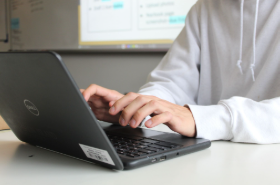
Last year, one class I took stood out to me for a very particular reason. Mr. Marsh's world history was unusually easy to focus in. It was like the things that typically prevent me from being productive just weren't there. Looking back on this, the answer to how he achieved that environment of calm and focus seems all too clear. He actually removed the distractions. To be precise, he removed the single biggest distraction in our school, and one that is present in nearly every class offered at VHS: Chromebooks.
As all VHS students know, Chromebooks are used frequently in our district. The reason for this is that teachers had no other option than to shift entirely to digital formatting when COVID hit (they could have technically printed out homework for students weekly and somehow gotten it to them, but realistically digital was the only option). Teachers rapidly transformed the way students are taught in a matter of months because they had to. Once COVID was over, most teachers never really went back to paper.
Chromebooks have some obvious advantages: teachers can assign things instantly, provide feedback quickly, and even grade automatically. This saves teachers a lot of time, so it's understandable why many use Chromebooks so liberally. It's also not a matter of "teachers use Chromebooks to save time because they're lazy." Many teachers hardly have enough time to prepare for their classes as is. Saving them time is a good thing for students and teachers alike. However, the problem is that Chromebooks come with a huge trade off.
The use of computers in education has been studied. Results consistently show that reading comprehension on screens is lower than on paper. It's not just a popular opinion; the data says paper provides an advantage over digital.
It is not a marginal difference. Students notice that they work better on paper. The sentiment around Mr. Marsh's class was overwhelmingly that the choice to not use Chromebooks resulted in an overall more enjoyable, more productive, and more enriching class experience than it would have been had we used them more often.
To be fair to anyone who disagrees with this, that class experience cannot be fully attributed to a lack of Chromebooks. Doubtless some of it was due to a teaching style that aligned well with myself and my peers, and also an interesting curriculum. But nearly everyone I've talked to expressed their appreciation of not using computers in that class and said that it helped them focus.
Different students give different reasons for this. A common one is that Chromebooks give people headaches. They, like almost all computers, require you to sit in an unnatural position for extended periods of time. The screens are harsh on your eyes, and those factors combined are a perfect recipe for a headache.
I think there is also a problem with how teachers see computer use. It may seem pretty insignificant healthwise for a teacher to assign a 20 minute task on a computer, and that may actually be true. But we have six class periods with different teachers who only see us for one hour. I think it is easy for them to forget that we're on Chromebooks in other classes too, and those 20 minute tasks add up to hours per day. That starts to become unhealthy. It's not a matter of teachers not caring, it's simply hard to keep in mind the full picture of our day when they only see one part of it.
Chromebooks have disadvantages in terms of health and depth of learning, but they also have another problem. They are boring.
A good class is interesting. A good curriculum makes students want to learn, it doesn't force them to. This is why we do labs in science instead of just reading textbooks. If some experiment is interesting enough to get a student's attention and motivate them to think about what's going on, it is far more effective than just reading about it. That's the whole point.
But in recent science classes I've taken, labs are being steadily replaced with something called "simulations". Basically, the teacher posts a link to a website that simulates an experiment on the computers, and students answer lab-like questions about what it shows is going on. I get that these have a purpose – they let us look at experiments that we don't have the ability to do in class. But there are also ways to demonstrate the same concepts using things we can do in class, and I believe even a relatively simple hands-on experiment is fathoms better at getting a concept to stick in a student's mind than "simulations" are.
The last problem I see with computers in class is that the educators are constantly fighting a system designed to be distracting. The internet, by design, is supposed to grab your attention. It is supposed to pull you away from what you're doing and pull you down a rabbit hole. Even though it goes on mostly out of sight, huge sums of money are spent on buying peoples' attention. This makes the internet an inherently distracting place.
Yes, the school does their best to fight these distractions, but it is a losing battle. It is the very nature of the internet to be distracting.
Chromebooks are a situational tool that have become severely overused. I am not trying to convince anyone that we should remove computers from education entirely, but we should try to limit them as much as possible. Teachers, next time you're going to give a digital assignment, please stop and ask yourself if it could be done on paper instead. As students we understand that this is not always possible, but when it is, it provides a more effective, enjoyable, and healthy education, and we appreciate it enormously.

Comments